

Changing consumer behavior is making retail harder to predict and harder to profit from. Shoppers are buying in ways that no longer follow old patterns of loyalty or prediction. Viral trends, fast shifts in preferences, and a constant feed of new products mean retailers who are not watching these moves in real time end up merchandising in the dark.
If your usual strategy feels like it is missing the mark, it is not just you. Consumers have moved, and many retailers have not kept pace.
Why Retailers Are Struggling to Keep Up
Traditional forecasting models were built for slower and more predictable cycles. Today’s consumer is unpredictable. They buy when they see something they want, not when retailers expect them to. TikTok Shop proves this every day. One viral video can create a flood of purchases overnight. Shoppers are making more impulse buys, influenced by creators, social proof, and urgency built into the platform.
The problem is not that consumers are buying less. It is that retailers are detached from what they are buying and when. Seasonal calendars and historic sales data do not capture the reality of someone spending $50 on a trending beauty product they just saw in their feed.
The Role of Real-Time Data
Data insights solve this problem. Instead of guessing at consumer behavior or reacting months later, retailers can see in real time which products are moving, how fast they are scaling, and which categories are trending.
If a skincare serum racks up millions in sales in a week, that is not just an isolated spike. It is a signal. Retailers who act on that data can adjust their assortment, negotiate better with suppliers, and get trending products on shelves before the wave slows down.
Impulse purchases are not the enemy. They are the new normal. The challenge is spotting them early enough to profit, not after competitors already have.
Loyalty Isn’t What It Used to Be
Brand loyalty has shifted. Shoppers aren’t sticking with one label the way they used to, they’re weighing speed, price, convenience, and the thrill of discovering something new. Many young shoppers turn to product “dupes” that give them the sense of affordable luxury. Overall, affordable pricing, free shipping, flexible returns, and limited-time bundles often mean more than a long history or strong reputation.
But that doesn’t mean older brands are irrelevant. On TikTok Shop, long-established names like Laura Geller Beauty (founded in 1993) still stand tall. Charm TikTok Shop data from January to August 2025 shows that the brand has pulled in $5.1M in revenue, selling nearly 196.6K units, with its Light and Full Coverage Kit alone generating $492K. Similarly, Kiko Milano (founded in 1997) is carving out space with its signature glosses, moving 2.1K units and bringing in over $35K.
At the same time, newer entrants like Skin1004 (2016) and Saie (2019) are rising fast. Skin1004 has made $475.4K in revenue from 32.3K items sold, while Saie’s popular Dew Blush has helped push the brand to $202K in sales.
Loyalty today is fluid. Established brands with decades of credibility are succeeding right next to brands less than a decade old. On TikTok Shop, the playing field is open to both. What matters is not just history or novelty, but how well a brand responds to real-time shopper behavior, whether that’s pricing, bundles, or the right creator-driven push.
Discounts Are Part of the New Norm
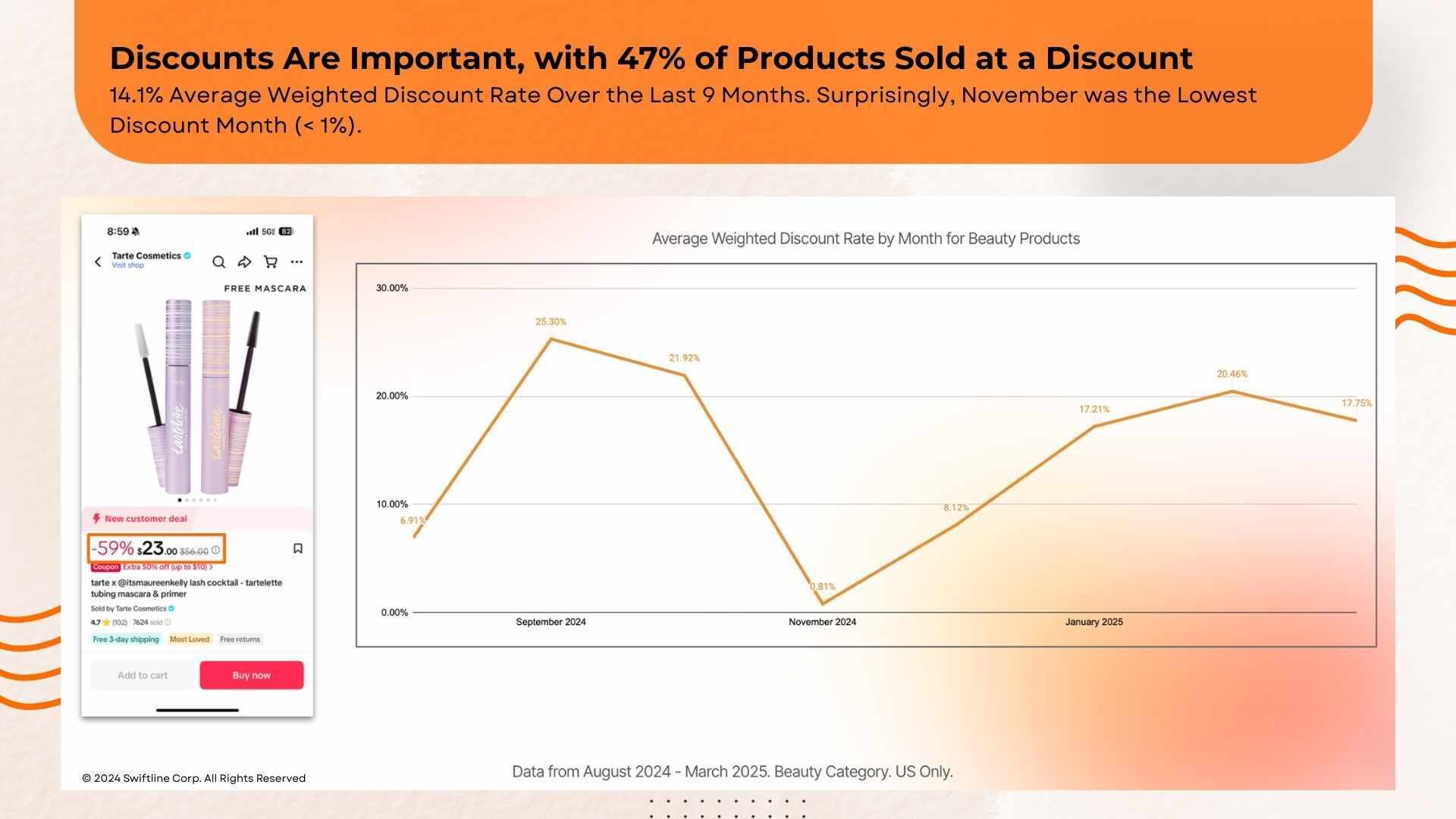
Discounting is now a regular part of how people shop. In Charm data, nearly half of all beauty products on TikTok Shop were sold at a discount over the past nine months. The average discount rate during this time was 14.1%, peaking at 25.3% in September. Even in November, the usual high season, discounts dropped to under 1%, showing shoppers don’t wait for big sale events anymore.
Retailers need to know which products to discount, when to do it, and how much to offer. Guessing leads to lost margins or missed conversions. Using Charm makes that decision easier as they have data on average price points alongside the products that actually drives sales. This information helps retailers run smarter promotions that protect profits while matching buyer expectations.
What Retailers Can Learn From Old and New Brands
For retailers, the lesson is clear: stock both heritage names and rising stars. Older brands bring trust, proven product performance, and repeat buyers. Newer brands bring hype, social-first storytelling, and trend-driven sales. By blending the two, retailers can capture shoppers who want consistency as well as those who crave discovery.
TikTok Shop data shows that consumer loyalty isn’t tied to a brand’s age, but it’s tied to whether the product matches what people want right now. Merchandising strategies should reflect this mix, to balance reliable SKUs from established players with experimental offerings from newer brands to stay relevant across different shopper mindsets.
Don’t Guess What Consumers Want, Track It
Changing consumer behavior isn’t slowing down. And the brands that succeed will be the ones that don’t wait for outdated reports; they’ll act on signals. Shoppers are responding to pricing, trust, content, and convenience in new ways, and the data proves it.
Charm helps retailers respond to these shifts in a measurable way. Its merchandising insights show which products are selling now, what pricing patterns are working by category, where discounting drives conversion, and which creators and channels deliver the highest ROI. With these signals, teams can test new categories, adjust product positioning, optimize their product assortment, and fine-tune promotions based on actual buying behavior instead of assumptions.
Book a call with Charm.io today and see how you can match your store’s merchandising strategy to what consumers actually want right now.
See what’s trending in your industry
Charm’s Trend Watch is a monthly webinar that shares data and insights into fast-growing DTC brands, TikTok Shop trends, and strategic market opportunities.
Sign up for the Webinar